
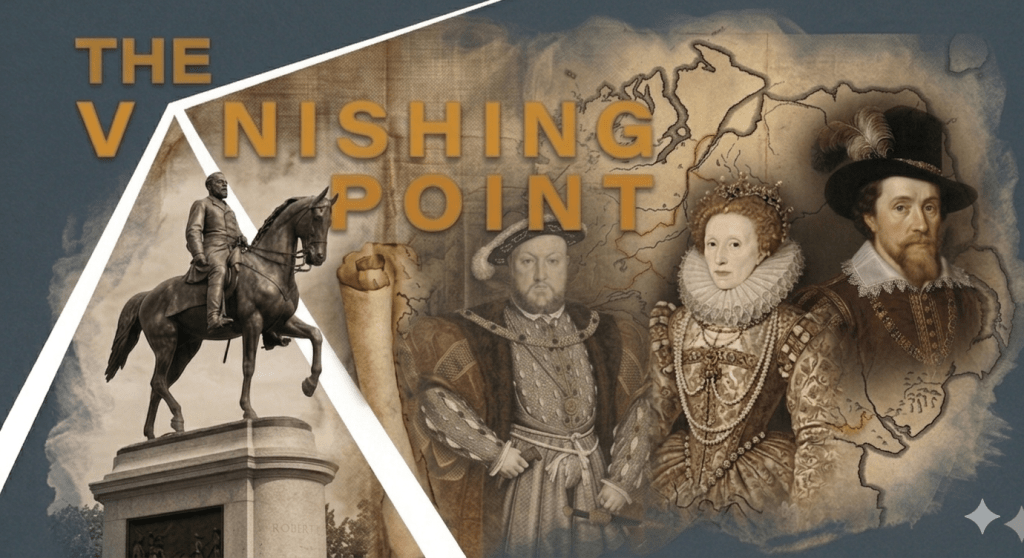
What if I told you that global elites engaged in a massive project to replace existing populations with more ‘compliant’ peoples brought in from across the world?
You might assume I’m referring to the unfounded and racist Great Replacement Theory. But, what if I told you I am describing the very documented, state-sanctioned, and controlled migration of people by European maritime empires?
While modern conspiracy theories imagine a secret plot, history records a literal one: the systematic uprooting of millions to fuel colonial avarice.
This project, Vanishing Point, explores where myth diverges from reality, contrasting popular conspiracy theories with parallel real-world events that actually shape our lives. Our mission is to reveal the hypocrisy of conspiracy theorists, expose the systemic damage they cause to our society, and give a voice to the vulnerable people they victimise in pursuit of a phantom.
Today, I’m writing about the baseless Great Replacement conspiracy theory in contrast to the history of forced migrations intended to displace existing populations who are seen as barriers to imperial projects.
The Great Replacement Conspiracy Theory
On the night of August 11th 2017, white nationalist rally goers at the Unite the Right Rally marched through the streets of Charlottesville, North Carolina, chanting “You will not replace us!”. As the tiki-wielding wannabe master race snaked through the streets of this quiet university town, their chant subtly morphed; “you” becoming “Jews”, giving the explicitly antisemitic “Jews will not replace us!”.
In the immediate aftermath, most people assumed that this chant was an assertion of white superiority, claiming that Jewish people were no match for the rally goers who were essentially irreplaceable and without whom society would collapse. But in the wake of the rally, which culminated in the murder of counter-protester Heather Heyer by a while supremacist terrorist vehicle attack, it soon became apparent that the chant was a reference to a much darker paranoid conspiracy theory.
The Great Replacement theory was formulated by Chateaux-dwelling French aristocrat Renaud Camus and given form in his 2012 essay “Le Grand Replacement”. Apparently inspired by Camus’ work as a travel writer, he claims to have been affronted by the sight of hijab clad Arab women populating the picturesque villages of rural southern France. The concept represented a fusion of two cultural bug bears that had been fomenting in Europe since the 2008 financial crisis: a conspiratorial resentment of financial elites and a growing Islamophobia, as evidenced by upticks in anti-Muslim immigration rhetoric and violence.
In 2009, for example, the British National Party won two seats in the European Parliament, running on an anti-immigrant and anti-“radical Islam” platform 1. In the 2010 parliamentary elections, Gert Wilder’s anti-immigrant Dutch Freedom Party increased its number of seats from 9 to 24, gaining 15.5% of the national vote and becoming part of the governing coalition. In 2011, Norwegian neo-Nazi Islamophobe Anders Behring Breivik killed 77 people in terrorist attacks intended to punish the Norwegian Labour Party for its supposed multiculturalism.2
It is worth noting that this wave of anti-Muslim sentiment preceded the 2015 Mediterranean migrant crisis and both the Charlie Hebdo and Bataclan terrorist attacks. When Camus was writing, the rise in anti-Islamic sentiment was not being motivated by any genuine concern or pressure from immigration. Instead, it was driven by political fearmongering and demagoguery, even occurring in countries with little to no increase in Muslim populations, such as Lithuania3.
Camus considered then French President, and former banker, Emmanuel Macron a “force of replacement”; an example of “Davoscracy”4 – explicitly linking the supposed replacement of white Europeans by Muslims to the financial elite as sponsors. Indeed, this was seen as Camus’ great addition to the “White Genocide” conspiracy theory; the removal of a Jewish cabal as the shadowy hand behind immigration, replacing it with the dog whistle “replacing elites” (an innovation soon undone by the chanting mob of neo-Nazis at Charlottesville).
For sure, Camus’ Great Replacement has its explicitly anti-Semitic precursors; Eduard Drumont, the 19th century French proto-Nazi wrote in 1886 of an eternal war between the “Aryan” and the “Semite” which he claimed had seen the advance of a silent invasion from Lithuania to France, a “soft takeover accomplished [by] chasing the indigenous people from their homes, their source of income, in a velvety way depriving them of their goods, their traditions, their morals, and eventually their religion.” 5
If Drumont saw the Jews as architects of their own migration, Adolf Hitler saw them introducing a third party into the equation; in Mein Kampf “It was and it is Jews who bring the Negroes into the Rhineland, always with the same secret thought and clear aim of ruining the hated white race by the necessarily resulting bastardization, throwing it down from its cultural and political height, and himself rising to be its master.”6
Hitler’s delusion was that miscegenation would dilute German/European blood, in his warped world view, weakening the race and making it easier to subjugate, rather than a strict displacement as in Drumont.
Fascist’ terror of race mixing persisted even after the horrors of the Second World War, and it seems like no sooner was the term “genocide” coined to describe the Nazi’s crimes than neo-Nazis appropriated it. In 1948, Rene Binet, a former French Trotskyist who transitioned to become the “father of white nationalism”, took offence at US stationing of black GIs in Europe, “We accuse the Zionists and anti-racists of the crime of genocide because they claim to be imposing on us a crossbreeding that would be the death and destruction of our race and civilization.”7
The idea of replacement became popular with European fascists again in 1973, marked by the publication of the novel the Camp of the Saints, a truly deranged fantasy of a spontaneous flotilla of millions of starving refugees fleeing India to make a beeline for France. Once there, they overwhelm the indigenous European population, who are poorly led by political elites and betrayed by leftist ideologs.
Gone now are the plotting puppet masters, replaced instead by hapless race traitors and weak liberals who are swept up in the tide of events. A favourite of both Stephen Miller and Steve Bannon, the novel became popular again in 2011, returning to the bestseller list in France and very likely a direct influence on Camus’s Grand Replacement. The Camp of the Saints, however, remains explicitly racist; there is no doubt that the displaced and belittled Europeans are the moral and cultural superiors.
In the ever-shifting sands that are the post-war effort by fascists to rebrand themselves and mask their true nature, it was the French Nouveau Droite movement that tried to soften the racism of the great replacement narrative, or at least remove the explicit white supremacism. Alain de Benoist, a founder of the movement, sought to portray his concern over cultural mixing stemming from its supposed harm to all races, writing in 1980 that his “greatest fear today” was the “progressive disappearance of diversity from the world. The leveling-down of people, the reduction of all cultures to a world civilization made up of what is the most common.”
This approach, developed by Benoist and the Nouveau Droite, became known as “identitarianism”. It wasn’t fascinated with race and racial superiority as the old fascists had been; instead, it was concerned about identity: culture and ethnicity. A dog whistle, of course, a facade plastered over the long-standing fearmongering of a dilution or displacement of white Europeans, but one that has become very successful and is detectable in every right-wing pundit or politician who espouses the value of, and threat to, European culture or values.
In 1999, Benoist published his Manifesto for a European Renaissance, which would become an inspiration for the far right in Russia, across Europe, and in the USA.
Architect of National Bolshevism (so-called Nazbolism), Aleksandr Dugin, flew to Paris to meet Benoit and told reporters in 2012 that “I consider him [Benoist] to be the foremost intellectual in Europe today.”8
In Europe, Benoist’s manifesto inspired Identitarian movements throughout the 2000s. Jeunesses Identitaires was founded in 2002 (succeeded by Génération Identitaire in 2012, which was then banned in 2021), and its youth movement, Bloc Identitaire, launched in 2003. In France, this group indulged in a style of “ironic” dog-whistle anti-Muslim activities that anticipated the “own the libs”, edge-lord faux irony of the 2010s alt-right. Such as a 2006 campaign to distribute pork soup to homeless people in predominately Muslim neighborhoods, or, clearly brimming with original ideas, a 2010 “pork sausage party” at the Arc de Triomphe (planned for outside a mosque, but moved on by police after being banned), or the highly original 2011 “march of pigs” protest in neighborhoods with large Muslim populations, feasting on wine and pork, claiming that such things would soon be illegal in France because of Muslim immigration.9
But the porcine mono-joke was not the French Identitarians’ only achievement; they managed to forge networks in other countries, turning identitarianism first into a pan-European movement, and then into a transatlantic one. Within six years of forming, Bloc Identitaire was recorded as having links to groups in Italy, Belgium, Spain, and Austria, and as inspiring or establishing new groups in Switzerland, Portugal, and Spain. In the 2010s, they pushed further into Europe, establishing connections with, or otherwise inspiring, groups in Germany, Italy, the Czech Republic, the UK, Ireland, Hungary, Slovenia, Denmark and Russia.10
Bloc Identitaire targeted youth with flyer campaigns and social media, presenting its members as ordinary people, removed from the bother-boot skinheads and racist thugs of earlier times.
As the movement grew, it was able to perform bigger, more eye-catching stunts, and against the backdrop of an actual migrant crisis, hiring helicopters to chase down migrants attempting to cross the Alps into France 11 , and blocking NGO vessels from attempting to launch rescue missions to recover stricken migrant boats in the Mediterranean12 .
Identitarianism was slower to catch on in the USA, perhaps as a consequence of the early Identitarian rejection of “hamburger colonialism” in defence of their European identity. Perhaps also due to the American right-wing obsession with race and racial superiority, being unable to accept the subtle dog whistle of the European movement. But a younger generation of the American far right was beginning to take notice of their European counterparts’ success in recruiting young people to their cause.
American neo-Nazi and coiner of the term “alt-right”, Richard Spencer, invited Benoist, the father of Identitarianism, to speak at his National Policy Institute conference in Washington, D.C. in 201313.
To further promote the movement, Spencer ran an identitarian essay-writing contest for under-30-year-olds and, as part of his efforts to form links with Europeans, in 2014, he organised a “European Identitarian Congress” conference in Hungary.
That same year, Nathan Damigo, a U.S. veteran, was released from prison after serving a sentence for the armed robbery of an Arab cab driver. Attending college while trying to piece his life together, radicalised by his two tours in Iraq, PTSD, and his time inside prison, Damigo teamed up with another veteran to launch the National Youth Front as a youth wing of the white supremacist American Freedom Party. Damigo planned to take inspiration from leftist and BLM recruitment of college students and combine it with the slick messaging and showmanship of the European identitarian movement.
The National Youth Front would soon fall apart, and Damigo would go on to form his own organisation, Identity Evropa, in March 2016 – just in time for Trump’s run for office. And it is through Damigo and Identity Evropa that Camu’s Great Replacement theory enters the US far-right bloodstream. (Or blood-and-soil stream).
The use of “You will not replace us” appears to have started in early February 2017 when members of Identity Evropa, along with Damigo, showed up at the Museum of the Moving Image in New York City to disrupt actor Shia LeBeouf’s anti-Trump live-stream art installation project called “He will not divide us.”
LeBeouf’s project was almost immediately beset by far-right trolls empowered by Trump’s victory. They emerged blinking into the sunlight from behind their keyboards to manifest irl displays of their meme warfare; barging into the live stream to throw Hitler salutes, replete in replica Nazi uniforms and performative milk drinking, a 2016 far right favourite harking to supposed European tolerance of lactose and concepts of milk’s whiteness and purity.
Damigo travelled from California to New York to add to the disruption, saying directly into the camera, “Shia LeBeouf, you will not replace us with your globalism.” Notably, LeBoeuf’s mother is Jewish, and he was raised in a mixed Christian-Jewish household.
During periods of noisy, racist disruption, LaBeouf and the project’s custodians would attempt to drown out the vandals with chants of “he will not divide us!”14
Damigo’s flying monkey henchmen joined in, howling repeatedly, “You will not replace us!”, matching the rhythm and cadence of the organisers’ chants.
The slogan soon began appearing on Twitter as a hashtag and started showing up on white supremacist flyers posted at universities around the country. The flyers listed a variety of white supremacist websites, such as The Right Stuff, Altright.com, a site started by Richard Spencer, and RedIce.TV, a white supremacist online television and radio show.
The removal of Confederate statues in the wake of a murderous 2015 terrorist attack carried out by a white supremacist on a historically black church in Charleston, South Carolina, had become a lightning rod for right-wing agitators. Seeing Trump’s assumption to the presidency in 2017 as an empowering endorsement of their world view, the far right were now pushing back against the initial surge of national revulsion that had seen a slew of confederate symbols removed from the public sphere.
On May 13, Damigo and Richard Spencer led white supremacists protesting the planned removal of Confederate monuments in Charlottesville, Virginia, in chants of “You will not replace us,” as members of Identity Evropa carried a banner bearing the slogan.
A week later, two Marines were arrested after they unfurled a banner on a building that included the letters “YWNRU,” the acronym for “You will not replace us.” The two had attended a pro-Confederate rally in North Carolina.
Meanwhile, the Great Replacement theory was gaining traction in the US white nationalist movement, with influencer Lauren Southern posting a YouTube video on the topic in July. Southern also took part earlier in that year in the Génération identitaire action blocking NGO ships from a search-and-rescue mission for shipwrecked refugees and migrants in the Mediterranean Sea.15
Riding the wave of fascist enthusiasm that was year one of Trump’s first term, an assortment of beyond-the-pale far-right organisations started planning the Unite the Right rally as a public display of their resurgent power and unified resolve. Identity Evropa and Damigo were front and centre in organising the rally, taking the lead in “organising white supremacist participation”, at least according to their co-organiser, and co-accused, Richard Spencer, during their civil trial as organisers of the rally16.
Charlottesville, Virginia, was chosen as the site of the rally, under the guise of protesting a planned confederate statue removal, but also as an act of intimidation against what was seen as a progressive, liberal town in an otherwise conservative state, and against a black mayor who had irked the far-right mob.
It was to be a high point of the resurgent far-right in America – emerging unashamed to openly brandish their fascist credentials and Nazi memorabilia. It was to be the high point of Nathan Damigo, Identity Evropa and their identitarian Great Replacement scare -a triumph of the will as columns of torch wielding slobs goose stepped to chants of “Jews will not replace us!”
But it was to be short lived – even before the horrific act of violence that left one counter-protestor dead and 35 injured, the American public were aghast at the open display of hatred, and swastikas, and intolerance.
In the aftermath of the rally public outrage led to the acceleration of confederate statue removal – in all of 2017 prior to Unite the Right only eight statues had been taken down, and all of them in New Orleans. Within two weeks of the rally, about twenty statues came down in cities across the US.
Spencer and Damigo tried to get ahead of the story – holding an impromptu press conference in Spencer’s hotel room, casting blame towards the city authorities for somehow failing to adequately police their protest, an approach that did nothing to endear themselves to either the public they had disgusted or their fellow fascists, who they had disappointed.
Spencer tried to brazen his way through the fallout – engaging in a tour of college campuses in the following months. Beset by opposition and protests at every stop, Spencer abandoned his tour in March the following year after one of his followers opened fire on protestors. From being the acceptable face of the far-right Spencer began to sink into obscurity and irrelevancy. Almost – he maintained enough notoriety to be shunned from his local community, and remained an occasional punching bag for former rivals within the far right movement17.
For his part, Damigo saw the writing on the wall pretty soon after Charlottesville and quickly resigned as head of Indentity Evropa and disappearing from public view.
Except, that is, as a codeffendent with Spencer and 23 other people and organizations found liable in a civil law suit which awarded $25 mlion in damages to nine residents of Charlottesville who suffered physical and psychological injuries as a result of the rally.
But while Spencer and Damigo sank from the public consciousness, the hateful ideas they imported to the USA took root and continue to fester till this day.
Renaud Camus, the progenitor of Great Replacement theory, expressed shock at the idea that he may have inspired the Charlottesville mob “They are marching against Jews? They are Nazis? Then they cannot be inspired by me, who is the very contrary of all that.”18
His disavowal did not last long, in 2019, in an attempt to cash in on his notoriety, he released “You Will No Replace Us!”, his first book written and published directly in English.
While Unite the Right saw the messengers banished, the message went on to be championed by the forces of US mainstream conservativism. Fox News pundits including Laura Ingraham19, Jeanine Pirro20, Dan Bongino21 and, especially, Tucker Carlson22 all made explicit claims about replacement, as a plot of the Democratic Party to replace the existing electorate with illegal immigrants (who can’t vote); simultaneously a dog whistle excuse for hostility to Hispanic and latino populations, and a smokescreen for President Trump’s fearmongering of election cheating.
More disturbing is the embrace of Great Replacement by far right extremist terrorists, including: in October 2018, Robert Bowers killing of 11 people at the Tree of Life synagogue in Pittsburgh, PA, after writing a Gab post blaming Jews for bringing non-white immigrants and refugees to the U.S; in March 2019, Brenton Tarrant livestreaming himself killing 51 people at two mosques in New Zealand, he titled his manifesto “The Great Replacement”; in April 2019, white supremacist John Earnest killed one and injured three at a synagogue in Poway, CA. claiming that Jews were responsible for the genocide of “white Europeans”; In August 2019, Patrick Crusius killed 23 in a mass shooting at a Walmart in El Paso, TX, in his manifesto, he refered to a “Hispanic invasion” as part of great replacement; on May 14th 2022 Payton Gendron committed a mass shooting at a market in Buffalo, New York, killing 10, his manifesto promoted Great Replacement.
With the advent of Trump’s second term, Great Replacement has also been adopted by American political elites, shrouded in an identitarian mask; in his 2025 speech to European leaders at the Munich Security Conference, US Vice President, JD Vance, said mass immigration was Europe’s most significant problem, claiming that levels of foreign-born residents in Germany were at record levels and that increased EU immigration from non-EU countries is caused by “a series of conscious decisions made by politicians all over the continent, and others across the world”. I.e. political elites engineering ethnic replacement23.
A year later, Marco Rubio in the same setting warning of “an unprecedented wave of mass migration that threatens the cohesion of our societies, the continuity of our culture, and the future of our people”, punctuated with the identitarian dog whistle “we are part of one civilization- Western civilization” and warning about “the forces of civilization erasure”24.
Even washed up British former TV presenter Russell Brand, mid journey in his left to right transition (but before public allegations of rape and sexual assault made him swerve to the American far right) mused on multiculturalism in a distinctly identitarian way: “Do you imagine there might be tribes in Iceland that live differently from people in Senegal? Why don’t we put them in a room to kill each other until they agree whether it’s better to eat fish or Antelope?’”25.
Of course, there is no “Great Replacement” driven by replacist elites, to the extent there are genuine concerns over migration, the situation is often worsened, or even caused, by the cynical right wing forces pushing the conspiracy theories.
In the UK, for example, far right fearmongering on migration by politicians like UK Independence Party leader / former city trader Nigel Farage and Tory MP / hedge fund manager Jacob Rees-Mogg fed into the referendum on UK withdrawal from the EU. Post Brexit, cooperation between the UK and EU faltered, with the effect that undocumented immigration levels to the UK increased precipitously. The same far right voices who precipitated the crisis continued to agitate on the subject, resulting in anti-immigrant violence26, riots, protests of migrant housing and the adoption of hard line anti-migrant policies by mainstream political parties. Ironically enough, urgency and public concern around immigration are fueling the political fortunes of some of those same players. So, yes, wealthy elites are causing and benefiting from uncontrolled mass migration, but it isn’t the Jews or Davoscracy – it’s petty minded local populist opportunists.
As for the USA, politicians stoke fears over illegal border crossings from Mexico curtailing legal migration and implementing more draconian border controls. This essentially disincentivized seasonal migration of agricultural labor while incentivizing long term residence and settlement. Which allows those same political parties to fear monger about a demographic Great Replacement27.
But the ultimate irony is that the reason western liberal democracies have policies that accept refugees and migrants is because their failure to do so prior to the Second World War became a precipitating factor in the Nazi development of the holocaust. In July 1938, a conference was held by 32 countries in Evian, France to discuss the refugee crisis of German Jews fleeing Nazi persecution. The delegates expressed sympathy for the Jews, however most refused to admit more refugees. Hitler and the Nazi regime mocked the conference attendees for their empty words and lack of action, and they were able to use this inaction as a sign that all other countries harboured the same hatred for Jews as Germany but only the Nazis had the will to under take the necessary evil of exterminating them28.
And now today, the ideological children of those Nazis seek to lie and fearmunger the policies instituted as a bulwark against fascist cruelty as a conspiracy against no the fascists themselves.
So much for the fantasy of a great replacement, what then for actual replacement of indigenous populations engineered by greedy, scheming elites?
(A handy source for further reading on great replacement: The ‘Great Replacement’ Theory, Explained, published by the National Immigration Forum29.)
Planned Migration and Indigenous Replacement by European Maritime Empire
Forced migration of populations is likely nearly as old as civilization itself. For example, the Old Testament of the Bible (Jewish Torah) depicts two, arguably three, forced, or managed migrations: the Assyrian Exile, where the population of the northern kingdom of Israel was forcibly relocated to the neo-Assyrian empire; the subsequent repopulation of Israel with other peoples conquered by the Assyrians; and the Babylonian exile of elites from the southern kingdom of Judah to the neo-Babylonian empire. All of these events are attested, to some degree, by external sources, archeology and even genetic evidence30.
But to encounter a managed policy of migration with the express intention of displacing, out breeding, or otherwise replacing an indigenous group of people with another, we probably need to start with what is arguably the original sin of the English – the imperial conquest of Ireland.
A little over a century after William the Conqueror’s invasion of England which replaced the Anglo-Saxon elite with a Norman nobility, an Anglo-Norman mercenary army landed in Ireland. They were there in the service of a local king who was seeking to reclaim his crown in return for swearing loyalty to the English king along with gifts of land to the Norman leaders.
From this toe-hold much of Ireland would come under English control until about 1300 when a series of plagues, invasions, and wars undermined English supremacy. By the 15th century, direct English control had shrunk to an area called the English Pale; roughly encompassing Dublin and the surrounding areas.
The descendants of Anglo-Norman settlers had largely acculturated to the native practices becoming “more Irish than the Irish themselves”, or perhaps, as some preferred it, succumbing to “English degeneracy”31.
The English crown was largely disinterested with Ireland, more focused on its European adventures and its efforts to keep France English. But that changed with Henry VIII’s religious reforms, his conflict with the pope and ultimate excommunication from the Catholic Church. All of a sudden, Ireland became a back door to England’s exposed west coast; a potential staging post for an invasion force from popish Spain or France32.
This was not a frivolous concern – Ireland had already served as a refuge for two pretenders to his father, Henry VII’s, throne33.
Things came to a head in 1534 when one of the senior families charged by Henry with governing the Pale went into open revolt. Henry successfully put down the rebellion and committed to bringing the rest of Ireland under English control34.
Henry’s efforts focussed on political means, he offered the various Irish lords royal protection from the English crown if they would become loyal to him, under a policy known as surrender and regrant.
The policy was initially a success; the Irish nobility assumed that the new system would function pretty much as the existing Gaelic system had – Ireland had a concept of the “High King”, a suzerain with a degree of limited authority over the subordinate lords who, themselves, had autonomy over their own lands which they owned in their own right. But the English intention had been to fundamentally reform Irish society by steering it towards a feudal system where lords owed their position to the king and were governed by a centralized government under the crown.
Henry VIII was able to allay Irish hostility to his reforms through bribes of English titles and church land confiscated as part of his religious reforms. But all was not plain sailing and the Irish nobility continued to chafe against the new system even beyond the end of Henry’s reign.
During the short reign (1547 -1553) of Edward VI, English policy on Ireland remained unchanged. It was during the even shorter reign (1553-1558) of his half sister, Mary I, however, that things got a bit spicier.
A Catholic bent on reversing the reforms of both Henry and Edward, and consort to Philip II of Spain, Mary had less to fear from Ireland as a staging post for foreign invasion. She was, however, determined to push on with her father’s program of societal change in Ireland. Her innovation was the development of plantations.
These were intended to be model communities populated by settlers from England; exemplary demonstrations of the benefit of the new market economies from which the indigenous population could take inspiration from.
It is not entirely clear if the term plantation originated in the idea of introducing or establishing a colony (i.e. planting people) or if it was a reference to “planting crops” in contrast to traditional Gaelic pastoralism (i.e cattle herding).
The land for these plantations was to come from land seized from Irish lords who were considered rebellious to the crown. The first of these was in Leinster, where land was confiscated from the O’Moore and O’Connor clans, who had a history of raiding the crown-ruled Pale.
This marked the start of a program to extend English control into hostile regions by managed migration of compliant populations to replace a troublesome indigenous one.
The displaced Irish did not take kindly to the new plantations, retreating to the surrounding hills and bogs from where they mounted an insurgency against the colonists that would last 40 years.
The ongoing violence made it difficult for the crown to recruit colonists and the plantation settlements ended up clustered around a series of military fortifications. These proved to be disastrously expensive to protect.
By the time queen Elizabeth I succeeded Mary to the throne in 1558, defense of Ireland cost a whopping 10% of England’s revenues.
Ireland was a burden for the Virgin Queen, or Protestant whore, depending on your sectarian preference35. Expensive to defend but essential to maintain unless it become a staging ground for an invasion from Catholic France or Spain. Her policy towards Ireland became one of pacification and reaction – not wishing to precipitate problems, but responding to revolt or invasion as required.
Elizabeth did, however, oversee an innovation in the plantation system; venture capital!
The program of exemplary plantations was to continue with English administrators instructed to find old monastic land now owned by the state and available as potential sites for colonization (rather than land seized from locals).
In an example of blending personal interest with public office, one of those administrators was related to a group of influential courtiers known as the West Country Men. These adventurers were pushing Elizabeth towards a more expansionist, imperial foreign policy and with the queen’s approval they formed a joint stock company to fund a plantation in Kerrycurrihy, Co. Cork. The plantation was established on a combination of former monastic land, purchased from the state, and adjoining land leased from the local Irish Lord36.
Within a year they had somewhere between 100 to 200 English settlers on the plantation
Buoyed by that early success the consortium behind the plantation soon became more ambitious. They initially planned a second colony, but broadened their vision to a conquest and colonization of the entire southwest portion of the province of Munster. This scheme would be privately funded, but with additional financial support from the crown – a 16th century PPI.
However, the adventurers turned out to be somewhat messy bitches, drunkenly bragging of their plan and royal backing throughout the taverns of London. Word evidently made its way back to Ireland triggering the First Desmond Rebellion in June of 1569, named after the dominant Irish family of the area, and, unfortunately enough for the projectors of the Kerrycurrihy plantation, the landlord for their site.
The nascent colony was the first target for the Irish rebellion, and every occupant slaughtered. But the rebellion faltered and English forces engaged in a scorched earth policy that caused many of the rebel lords to leave the rebellion and defend their lands. Barbarity and terror were a hallmark of the English, with one of the leaders – a West Country Man and half brother of Walter Raleigh – notorious for killing civilians at random and setting up avenues of severed heads at the approach to his camps.
The main rebellion was quashed before the year was out, but the surviving rebels waged a guerilla campaign for the next three years. There was an attempt to revive the Kerrycurrihy plantation, but the ongoing warfare meant it was a heavy loss maker, and the Queen put a halt on any further plantations in Munster. For the time being.
The leader of the rebellion finally surrendered in 1573, in exchange for his life and banishment from Ireland. As part of Elizabeth’s policy of trying to pacify the Irish population, she reinstated the earls of Desmond whose imprisonment in England had contributed to the outbreak of rebellion. Their jailer during that time? None other than the lead backer of the Kerrycurrihy plantation, which they promptly raided upon being returned to their lands.
The First Desmond Rebellion had also effectively terminated a much larger colonial enterprise planned for the other side of Ireland – Ulster, in the North East. These investors (once again involving the West Country Men) were aware of the problems faced by piece meal plantations such as Kerrycurrihy, so instead they planned to settle a colony of 2,000 people. This would require the removal of the local population. Indeed, that was part of the point, the sponsors of the project claimed that removing Scottish settlers who had been granted land by the local Irish lord was necessary for securing the peace of the region. But, by all accounts, the project was abandoned in 1570 when Elizabeth failed to back it37.
Despite Elizabeth’s apparent desire to appease the locals, simmering resentments continued.
In Europe the exiled leader of the First Desmond Rebellion was able to raise a sizable army with support from the Pope and the Spanish king. Ten years and one month after the first, the Second Desmond Rebellion commenced in 1579 with the landing of an invasion force on the south west coast of Ireland. And with that foreign invasion, the worst fears of the Tudor monarchs were realized.
The rebellion quickly picked up support from the embittered lords and chieftains in Munster and in Leinster. A devastating war was waged across the southern part of Ireland for the next three years. Both sides engaged in atrocities and targeted civilian populations, destroying crops, livestock, and homes. The result was famine, diseases and malnutrition.
By the end of the rebellion large areas of Munster had been effectively depopulated – perhaps a third for the entire province had perished. The lands of the rebelling Munster lords and clans were confiscated by the crown and were to become the Munster Plantation38.
This was the first large scale plantation and was intended to import over 11,000 English settlers (although it is estimated number were between 4,000 and 5,000). As with the Kerrycurrihy plantation before, a strong private finance element was a feature of the endeavor, with the plantation effectively outsourced to investors who could pick up land for pennies an acre. Individual enterprises, backed by groups of private investors, would be responsible for recruiting settlers to work the land.
The next major rebellion, the so called nine years war, was to kick off in 1593.
Due to its geographic isolation, English incursions into the northern province of Ulster had been relatively small, and so it remained a bastion of Irish Gaelic culture.
In the early 1590s English attempts to install administrators resulted in resistance from local leaders which escalated to an insurgency. English attempts to end the rebellion relied on assistance from Hugh O’Neil, a local magnate, who had amassed a sizable and well supplied private army and hoped to be installed as the governor of the region after an English victory.
When he realized that Elizabeth was not inclined to give him that level of power, O’Neil joined the rebellion. With O’Neil’s assistance the rebels achieved the upper hand by 1599 and inspired almost the entirety of Ireland’s nobles to join the rebellion. This is now seen as a pivotal moment in the development of an Irish national identity.
But the English crown was soon to turn the tide. By 1601, the rebellion had been brought under control in the southern province of Munster – but not before the Irish rebels had rampaged through the plantations there39.
Both sides committed atrocities against the civilian population: the English sacked the countryside to deprive rebels of supplies and force them to return to defend their own lands; On a march to meet a Spanish invasion force, O’Neil’s army devastated the lands of any Irish lord who did not support him.
The rebels’ efforts to link up with the Spanish was turned around by the English and they retreated back to Ulster in disarray. Thereafter, they were reduced to guerrilla tactics for the remainder of the war. Famine broke out in the winter of 1602/3, with an estimated 60,000 deaths among the civilian population. One of the senior English military leaders explained his position “a million swords will not do them so much harm as one winter’s famine”40.
The war would end later that year, just a few days after the death of Elizabeth I. The incoming king James I took a light touch with the leaders of the rebellion, pardoning them and returning their lands with conditions that they reject traditional Gaelic practices and adopt English ones.
Despite this apparently leniency, the rebels were discovered planning another insurrection and, in 1607, fled Ireland to mainland Europe to avoid capture and recruit foreign support for their planned rebellion.
But it wasn’t to be, James considered the Irish lord’s lands forfeited and laid plans for the most ambitious colonial project yet, the Ulster Plantation.
The Ulster Plantation was to be far more coordinated than the previous efforts in Munster. It would create a network of towns and forts to protect the plantations and to become a focus for economic activity and growth. Colonies dispersed among indigenous land had proven to be easy targets for rebel armies, so the new Ulster Plantation would see colonists established in contiguous areas around the new towns and garrisons; any land granted to indigenous lords was relegated to specific areas.
Venture capitalism was still front and center – Company of London investors were granted the entirety of a new county which they called Londonderry41. But James brought something new to the project; Scotland. More specifically, Scottish protestants.
James I of England also happened to be James VI of Scotland, and while the two countries remained politically independent, they were united under his crown. This meant that he could now pull upon the Scottish population as settlers for his new Irish plantation.
In 1622, an audit of the new plantation counted 12,000 settlers from the British mainland, more than half of whom were Scots. This was only the official numbers, uncounted were the numbers of undocumented settlers who had hopped across the narrow north channel of the Irish Sea separating Scotland from Ireland.
As with the previous ones, the Ulster Plantations were to serve as examples to the locals and were to be populated by Protestant English and Scots.
James hoped that their civilizing would “induce obedience, civilitie and Christian policie into those parts to the welfare and tranquilitie of the whole realme”.
Despite his hopes, disputes remained between the crown and the Irish land owners, but these were generally managed through political and judicial means and the decades after the establishment of the Ulster Plantation remained relatively stable.
This stability spurred further Protestant immigration to other parts of Ireland. By 1641 it is thought that as much as 100,000 British immigrants had settled in Ireland, split roughly 70:30 English to Scots.
Pretty much the entirety of the British isles was flung into civil war in the middle part of the 17th century in a series of conflicts that came to be known as the War of the Three Kingdoms. In Ireland this devolved into an ethnic conflict between Irish Catholics on one side and Scots and English Protestant settlers on the other. The conflict in Ireland was ultimately brought to an end through the famously genocidal campaign of Oliver Cromwell in 1653.
Four hundred years after the founding of the Ulster Plantation we are still living with the consequences. In many ways the English attempts to reform Irish society met their aims – by the 18th century much of Ireland labored under a market economy, leases were paid in cash, not service, semi-nomadic pastoralists had given way to tilled fields and agriculture, the chieftain replaced by the landlord.
But the plantations created divisions in society, often arbitrarily: the originators of the Drummond rebellions against the English queen Elizabeth were themselves “Old English” – families who had come to Ireland as part of the original Anglo-Norman invasion from England; the abandoned Elizabethan plans to colonize Ulster were justified because Scottish settlers were a threat to the peace, a generation later, James populated the Ulster Plantation with Scottish settlers as examples to the locals. Gaelic-Irish lords sided with the English or against them depending on where they thought the advantage lay. Why wouldn’t they? There wasn’t a concept of “Irishness” until the English invaders instilled it in the indigenous population.
And today, the political and sectarian divisions that persist in the island of Ireland can be traced back to the plantations: the Protestant loyalists descendants of the English and Scottish settlers, the Catholic republicans, descendants of the Gaelic Irish.
The English and then British rulers of Ireland had long since used religion as both a proxy for ethnic identity and a tool for anglicisation. Parishioners of the Church of England were granted more property rights than those of the Church of Scotland (as nonconformists or “Protestant dissenters”), while land owning rights of Catholics were severely restricted42. Thus the Irish were denied property unless and until they accepted English habits and lifestyles.
As part of the formation of the Irish Free State in 1922, the island of Ireland was partitioned so that the area broadly aligned with the old Ulster plantation remained in the United Kingdom as the province of Northern Ireland. Society in the north was bitterly divided and its administrative functions dominated by Protestants, thus leaving the Catholic population neglected or even targeted for persecution by government authorities. In the late 20th century those resentments and divisions spilled over to a period of violence known as “The Troubles”. Throughout the 1970s and 80s the British state participated in a series of massacres and extrajudicial killings – including supporting Protestant paramilitary groups that targeted the Catholic population – in a way the British general public has not fully come to terms with and would find horrifying if it were to fully comprehend.
The troubles ended with the Good Friday Agreement of 1996. Part of that agreement was free movement of people between Northern Ireland and the Republic of Ireland, which was easily facilitated by the UK’s membership of the EU. After Brexit, however, this became a contentious issue as the British government and EU tried to juggle free movement of people while maintaining a hard customs border.
The threat of losing that connection to the south, while increasing the separation with the rest of the UK means that Brexit has become an existential threat to the continued existence of the UK as a political entity. Brexit, which was largely driven by English nationalism with a complete disregard for the other nations of the United Kingdom, now seems to be increasing support in Northern Ireland for Irish unification, even amongst groups traditionally considered as British descendants of English and Scottish settlers. If trends continue, it is estimated that unification could win out over British loyalism by 202843.
It’s ironic, perhaps, that the same English chauvinism that drove the colonization of Ireland since the 16th century could be the root cause for the break up of the United Kingdom in the 21st century.
But the legacy of the plantations can be felt further afield. Those same West Country Men who pushed Elizabeth I into commercializing the Irish Plantations were also pushing for English colonization of the New World. Ireland was the testing ground and they took the same plantation model with them to North America with the Virginia Company. We sometimes forget, peering through the prism of history, that the sequence of events was not inevitable. Other paths were open to the English adventurers, English colonization differered from Spanish conquista, for example. Even the Plymouth colony offered a different model from the earlier Virginia colony44.
It was the plantation model that dominated English early colonial efforts of the Americas and it was dogged by many of the same problems. Notably a reluctance of volunteer colonists willing to give up their stable lives in exchange for an uncertain future, subject to attack from indigenous peoples, wild animals, famine and disease.
Many of the early workers were from those troubled border lands of the British isles, subject to spoilage, pillage and exploitation by elitist power games. Upon arriving in the new world, many would immediately desert their new masters, preferring to live outside “civilization” which had treated them so poorly, fleeing to the Appalachian mountains to become the ancestors of today’s much maligned “Hill-Billies”.
The plantation owners resorted to kidnapping or else bamboozling potential settlers through indentured servitude, but ultimately turned to slavery to stock their work force, a trick they learned from Spain and Portugal who had already adopted African slavery in order to back fill an indigenous population decimated by foreign disease and forced labour.
When the British finally abolished slavery in 1833 plantation workers in the Caribbean went on strike to demand a fair wage. Rather than pay their former slaves a living wage, British plantation owners decide to replace them with indentured workers imported from India.
From the Caribbean to Southern Africa, it was the British, through a centralized and controlled system of labour migration, who sought to replace black African labour with south Asian labour in order to undermine the organizing efforts of local workforces45.
And it was the ambition on English elites that gave rise to chauvinistic attitudes around British “civility” as wielded against the “savage” Irish that developed into attitudes towards indigenous peoples from North America to the Antipodes46. Whether it’s “manifest destiny” or “white man’s burden”, concepts of British, and then American, superiority justified land grabs, depopulated and genocide.
Some additional resources on:
Elizabethan Ireland – Turning Ireland English, By Professor Steven Ellis (BBC website)47
Tudors in Ireland – Englandcast, Episode 117: The English in Ireland (transcript)48
Conclusion
There is no Great Replacement of indomitable white people with more compliant brown ones, planned and managed by a secret jewish cabal. In fact, for the better part of the last four hundred years there has been an open program of managed migration of white people, by white people, to displace indigenous populations and establish European structures in places as diverse as Ireland, the Americas, Southern Africa, Australia and New Zealand.
The concept of replacing a population by covert social engineering is ludicrous. The Irish plantations never managed to displace the indigenous population entirely, colonists never became a majority of the population. They only came close to approaching a majority in areas where warfare, with accompanying disease and famine, and forced displacement had already largely depopulated the land.
So too in North America, where Europeans were only able to achieve a dominant population through forced displacement of indigenous populations already depleted by disease and war49
Far right fearmongering over a great replacement is a projection. Often it plays on and inverts earlier European imperialism.
In Britain, empire provided prosperity for generations. From the coal mines that fueled the ships that brought the raw materials back to the factories that made the goods, that were sold back to the empire. And yet the presence of people whose ancestry lies in the same imperial possessions that generated that wealth is somehow offensive.
France fought a bitter war to attempt to retain control of North Africa, yet the sight of a few people in North African dress in the south of france is cause for alarm.
In the 1840s the US waged the Mexican-American war, a land grab that netted over 500,000 square miles from Mexico, one sixth of the area of the contiguous United States. And yet today the presence of the indigenous people and descendants of Mexicans is a cause of national panic requiring deployment of the armed federal thugs and the army.
Conspiracy theorists are arbitrary In defining who are the subjects and who are the objects of replacement in their fantasy. In their flyers, European identity is represented by Greco Roman statues – a culture that has its roots in ancient Anatolia (Turkey – the Middle East). Sometimes they use Nordic symbolism and mythology, despite the fact that Nordic pagans raided Christian Europe to sell slaves to the Abbasid Caliphate.
Gaelic-Irish, Anglo-Irish, Scots-Irish have all been, at different times, at violent odds with each other, yet all find a seat in the pantheon of American White Supremacy. As too do southern European Italians and Greeks; groups once regected by nativist Americans and subject to violent lynchings and pogroms50 51.
Political elites stoke ethnic tensions for their short term benefits. In Britain, the engineers of Brexit now campaign on the back of a “migrant crisis” that they, themselves, created. Populist American politicians seek to score points against European liberalism by scolding EU leaders for dealing with a refugee crisis caused by two decades of war crowning more than sixty years of US adventurism in the Middle East.
The approach is effective: even liberal leaders warn of “legitimate concerns” over immigration and a supposedly left-wing government minister claims its racist to suggest that, just because she’s “a brown woman”, she shouldn’t be as racist as a white person52.
But pandering to the far right never works, because all it does is validate their argument and allows them to move on to the next strawman.
Instead of chasing the phantom of a great replacement, a clear view of history reveals that the true danger lies in the manipulation of ethnic fear by cynical elites, a tactic as old and as damaging as empire itself.
- https://www.theguardian.com/politics/2009/jun/07/european-elections-manchester-liverpool ↩︎
- https://www.aljazeera.com/news/2011/7/24/suspect-wanted-to-change-norwegian-society ↩︎
- Ross, A. R. (2017). Against the Fascist Creep. AK Press. Page 163 ↩︎
- https://www.newyorker.com/magazine/2017/12/04/the-french-origins-of-you-will-not-replace-us ↩︎
- Perry, Marvin, and Frederick M. Schweitzer. Antisemitic Myths: A Historical and Contemporary Anthology. Bloomington: Indiana University Press, 2008. Page 94 ↩︎
- Fredrickson, G. M. (2002). Racism: A Short History. Princeton: Princeton University Press. Page 119 ↩︎
- https://www.illiberalism.org/rene-binet-the-french-father-of-white-nationalism/ ↩︎
- https://keywiki.org/Alain_de_Benoist ↩︎
- https://www.counterextremism.com/supremacy/les-identitaires ↩︎
- https://www.illiberalism.org/an-identitarian-europe-successes-and-limits-of-the-diffusion-of-the-french-identitarian-movement/ ↩︎
- https://www.theguardian.com/world/2019/aug/29/french-court-jails-far-right-activists-over-anti-migrant-alps-stunt ↩︎
- https://hopenothate.org.uk/2017/08/17/failed-defend-europe-mission-comes-end/ ↩︎
- https://globalextremism.org/reports/generation-identity/ ↩︎
- https://youtu.be/B1HNDAaqCR8?si=XdTy9kgrpkhyzCu3 ↩︎
- https://www.theguardian.com/commentisfree/2020/aug/10/lauren-southern-is-on-the-comeback-trail-and-australian-conservatives-are-all-too-happy-to-help ↩︎
- https://www.integrityfirstforamerica.org/our-work/case/charlottesville-case/defendants ↩︎
- https://www.theguardian.com/world/2019/nov/04/white-supremacist-richard-spencer-racist-slurs-tape-milo-yiannopoulos ↩︎
- https://www.vox.com/world/2017/8/15/16141456/renaud-camus-the-great-replacement-you-will-not-replace-us-charlottesville-white ↩︎
- https://www.mediamatters.org/laura-ingraham/laura-ingraham-vote-republican-or-you-will-be-replaced-immigrants?redirect_source=/video/2018/10/16/lhttps://www.nytimes.com/2022/04/30/business/media/tucker-carlson-fox-news-takeaways.htmlaura-ingraham-vote-republican-or-you-will-be-replaced-immigrants/221711 ↩︎
- https://www.mediamatters.org/jeanine-pirro/fox-host-jeanine-pirro-pushes-white-supremacist-great-replacement-conspiracy-theory ↩︎
- https://www.mediamatters.org/media/3988904 ↩︎
- https://www.nytimes.com/2022/04/30/business/media/tucker-carlson-fox-news-takeaways.html ↩︎
- https://www.realclearpolitics.com/video/2025/02/14/full_speech_vice_president_jd_vance_addresses_munich_security_conference.html ↩︎
- https://www.state.gov/releases/office-of-the-spokesperson/2026/02/secretary-of-state-marco-rubio-at-the-munich-security-conference ↩︎
- https://rebuttingrb.blogspot.com/2023/08/russell-brand-right-wing-left-wing.html ↩︎
- https://hopenothate.org.uk/wp-content/uploads/2026/03/state-of-hate-2025-final-pdf.pdf ↩︎
- https://pmc.ncbi.nlm.nih.gov/articles/PMC3401567/ ↩︎
- https://ejewishphilanthropy.com/a-look-back-at-the-evian-conference-of-1938/ ↩︎
- https://forumtogether.org/wp-content/uploads/2021/12/Replacement-Theory-Explainer-1122.pdf ↩︎
- https://www.haaretz.com/archaeology/2019-09-27/ty-article-magazine/.premium/tablets-reveal-2-700-year-old-forced-relocation-by-assyrian-conquerors/0000017f-decb-db5a-a57f-deebd0950000 ↩︎
- https://historyireland.com/the-english-palea-failed-entity/ ↩︎
- Ireland in the reign of Henry VIII: the making of Tudor political theology, 1515-47, by James Leduc, Vol. 1 of 2, page 21 ↩︎
- https://carmichaeldigitalprojects.org/ireland/items/show/44 ↩︎
- https://www.englandcast.com/2025/03/the-silken-thomas-rebellion-2/ ↩︎
- https://hilo.hawaii.edu/campuscenter/hohonu/volumes/documents/ElizabethIofEnglandMaryIofScotlandAHistoryof16thCenturyBritainAnalyzedbySimonSchamaandJonathanW.Zophy.pdf ↩︎
- https://www.dib.ie/biography/st-leger-sir-warham-a8224 ↩︎
- The Elizabethan conquest of Ireland : a pattern established, 1565-76 by Canny, Nicholas P Page 62- 76 ↩︎
- https://www.theirishstory.com/2011/03/28/the-munster-plantation-and-the-maccarthys-1583-1597/ ↩︎
- https://academic.oup.com/histres/article/89/246/708/5603489 ↩︎
- https://muse.jhu.edu/article/926705/summary ↩︎
- https://www.bbc.co.uk/history/british/plantation/companies/londoncompanies_full.rtf ↩︎
- “Background to the Statutes; Religion: The Penal Laws”. History of the Irish Parliament 1692–1800. Ulster Historical Foundation ↩︎
- https://www.irishtimes.com/ireland/2025/02/07/trends-show-rise-in-support-for-irish-unity-among-northern-voters/ ↩︎
- “This Famous Island in the Virginia Sea”: The Influence of the Irish Tudor and Stuart Plantation Experiences in the Evolution of American Colonial Theory and Practice by Duff, Meaghan Noelle ↩︎
- https://blog.royalhistsoc.org/2020/01/29/beyond-this-day-29-january-1838-indian-indentured-trade-and-the-first-crossing/ ↩︎
- https://www.bartleby.com/essay/Savagery-In-Colonial-America-9CA89AF23673965E ↩︎
- https://www.bbc.co.uk/history/british/tudors/elizabeth_ireland_01.shtml ↩︎
- https://www.englandcast.com/2019/01/episode-117-the-english-in-ireland/ ↩︎
- https://en.wikipedia.org/wiki/Trail_of_Tears ↩︎
- https://en.wikipedia.org/wiki/1891_New_Orleans_lynchings ↩︎
- https://en.wikipedia.org/wiki/1909_South_Omaha_anti-Greek_riot ↩︎
- https://www.theguardian.com/politics/2026/apr/21/shabana-mahmood-swears-at-hecklers-over-reform-uk-comments ↩︎

